
The following is divided into three sections: a general letter (My Fiat), a letter to the Orthodox, and a letter to the Protestants. Happy New Year to all!
As the universal joy of the Christmas season amplified, the anxiety of the imminent deadline of my New Year’s resolution to decide between Orthodoxy and Catholicism only intensified. In the heart of December, a conversation with a close friend arose concerning the differences in the angelic revelations to Mary and Zechariah, which would providentially serve as the blueprint to resolve my own impending religious conundrum. At first blush, the two individual reactions to their respective visitations appear essentially equivalent, yet with inexplicably divergent results: Zechariah being punished with muteness while Mary being granted an explanation of the miracle. Church Fathers have addressed this illusory tension by underscoring that while Zechariah responded with doubt at the possibility of such a supernatural conception, Mary immediately accepted the revelation and then merely sought an elucidation of the miracle’s logistics as her oath of virginity muddied the nature of her participation in the conception. Although both had received a preliminary explanation of the purpose of the conceptions, Zechariah retained a desire for intellectual certitude before accepting the angelic message while Mary antecedently believed the miracle would come to pass prior to further investigating the details of the revelation. Therefore, Mary allowed her belief to color her reception of the angel’s decree, rather than imitating Zechariah’s need for an intellectual dissection to precede his submission. Her fiat, or her consensual affirmation of “let it be done,” would serve as an icon for me of a conversion formed by prevenient grace that accepts the truth of divine revelation in order to only then subsequently examine the logistics of the message through the matrix of belief.
• My Fiat •
My long path to Nazareth was, however, principally marked by Zecharian wanderings which most unfortunately, in retrospect, did not entail the punishment of muteness. I am, nevertheless, forever indebted to an upbringing that instilled in me both a desire for the truth and an impetus towards Christ despite any theological disagreements that have later developed. The cultural context of my immediate and extended family is a strong evangelical, Baptist lineage that I have never discarded out of any semblance of bitterness or rebellion, but in fact had always comfortably accepted as the closest approximation to Scriptural truth we could muster. Contrary to resentment, this framework cultivated in me a deep passion for doctrine that propelled me to pursue a theological degree at Baptist universities. Truthfully, however, I found the protestant paradigm intellectually deficient, although I refrained from admitting this reality to myself or my theological interlocutors. Unfortunately, yet perhaps providentially, my initial experience at a Baptist university in Kentucky was not remotely enjoyable, prompting me to move back home after a single semester. As I had presumed God would have willed that I pursue such a path, I remained quite perplexed and distraught at the moderately disastrous outcome of my efforts. After a few weeks at home without an inkling of direction on the horizon, I prayed that God would show me his will for my life going forward. Not normally inclined to the supposedly miraculous, much to my surprise, the following day a Catholic guest speaker presented at my non-denominational church discussing his organization’s pro-life work. The initiatives seemed pleasing to God from my perspective and I decided to submit an application while I took time off school to discern what general direction my life should take. Through almost five years of subsequent employment in the pro-life field, I would cultivate numerous relationships to which I am eternally indebted. Many friendships with Catholic coworkers were fostered, which, at the time, I considered another mission field secondary to the pro-choice individuals we encountered in our work. Through enlightening conversations with coworkers and volunteering clergy, I developed a more tolerant disposition to their otherwise scandalous theological paradigm. Yet, I remained altogether opposed to their positions generally, maintaining every intention of countering their supposedly heretical framework.
Chinks in my self-assumed ironclad armor began to manifest as I advanced further in my own theological studies at a local university, with a professor assigning the Anglican work Suprised by Hope which ushered in a revolutionary perspective that set the stage for a greater incorporation of apostolic doctrine. With this Anglican paradigm as the evolving backdrop, I simultaneously found my Baptist professors completely ignorant of Catholic dogma and in fact promoting outright falsehoods regarding their beliefs. As these realities compounded, a coworker gifted me a book on Mariology that surprised me with its biblical foundations and logical coherence. As I understood from my coworkers that the Eucharist stands at the core of Catholic theology, I decided it would be necessary to read Brant Pitre’s book on the sacrament to determine whether Catholicism was worth pursuing any further. With each turn of the page, my entire world flipped more and more upside down, while I progressively realized how incorrect I had been for years regarding such an essential piece of theology. Accordingly, I felt compelled to explore the writings of the early Church to determine whether the entirety of the Catholic Church’s claims could likewise be substantiated. Again, to my dismay, it became readily apparent that Protestantism retains no historical merit while the apostolic claims of the Catholic Church had in fact been legitimate all along. I continued to devour the patristic writings, as I immediately fell in love with their content which finally satisfied my longing for an intellectually coherent faith that subsisted in continuity with a rich Scriptural exegesis. Despite my enjoyment of the patristics, I concurrently grew utterly confused, as it had been ingrained in me from a young age that Catholicism was simply a medieval corruption of the original Church that devolved into the religion of the Antichrist over time. Yet, here I was studying nearly the totality of this Church’s tenets detailed IN THE FIRST AND SECOND CENTURIES. In desperation, I consulted a number of Protestant pastors to obtain their perspective, since I assumed they would provide an explanation for the historical record appearing to conflict with the mainstream Protestant narrative. Amazingly, they all admitted they had never read much of church history themselves despite obtaining theological degrees, confirming my dreadful suspicion: of course they never studied Church history, otherwise they would have ceased to be Protestant! It is not an understatement that at this point I felt disappointed by the people closest to me who had claimed to have done their homework but in reality operated out of pure instinct based in unfortunate ignorance. I had no intention of coming to this conclusion when I began my foray into history, yet it was the preponderance of the evidence that compelled me to such a verdict in a matter of months of patristic research. With the writing quickly developing on the wall, I enrolled in a Catholic catechesis class – however, not out of much conviction but principally deriving from intellectual inertia and intrigue as I remained undeveloped spiritually due to the expeditious nature of the theological epiphanies. As the catechesis approached its end, the COVID pandemic swept the nation and delayed official initiation into the Church. This provided an opportunity to more subtly retreat from a complete commitment to Catholicism, as the totality of my being had failed to embrace the faith. In fact, the rapidity of my intellectual immersion had ignited within me a significant bout of anxiety culminating in what can only be described in hindsight as a nine month panic attack.
Not only had events proceeded too expeditiously to truly internalize a substantial conviction, but as I continued to study history I became acquainted with the Orthodox Church which also laid claim to the ancient faith. I promptly fell in love with the spirit of the East, and as a result, in the summer of 2020, I decided I would simply devote a single month to the investigation of its claims compared to those of Catholicism. The disputes between the two Churches, however, were immensely more complicated and ancient than I could have initially imagined, and ultimately one month evolved into four years. The difficulties grew more pronounced when I attended an Orthodox Divine Liturgy for the first time which immediately had me enthralled; indeed, it stands as one of the most enriching experiences of my life. In contrast to the watered-down liturgies of the modern West and the stale artifacts of the traditional Catholic conclaves, the Orthodox embodied both the communal disposition and transcendent beauty of the ancient Church’s theology that had likewise enraptured me. Not only had this perceived liturgical superiority fostered within me a passion for the East, but as I studied patristics I noticed an intense focus on conciliarity that had been radically neglected in Western ecclesiology and apologetics since Vatican I. At this point, despite the love of my life herself being a cradle Catholic, my journey no longer remained simply a comparison between the East and West, but in many respects evolved subconsciously into an endeavor to justify the Church that had captivated my soul. Bluntly, it honestly appeared as if Orthodoxy had to be true, I mean look at it! For years, the majority of my days now consisted of enduring a political job I had grown to feel trapped in just so I could study as much Church history as possible during the evenings while meticulously documenting all the evidence I encountered in an online database. Perhaps a manifestation of total psychosis, I considered finding a new career an inefficient use of time when my eternal destiny remained at stake. Persuaded of the necessity of choosing between these two Churches for the fullness of salvation, nearly all temporal goods took a radical backseat. I gained weight, my cholesterol rocketed, I neglected exercise, and primarily ate out at restaurants in order to maximize my studies. In the background of most conversations, during date nights, amid familial events – whatever the occasion – I was either subconsciously or consciously attempting to resolve the theological issues underlying the Great Schism. Every night I prayed to the Father, the Son, the Spirit, the Mother of God, the Saints, and the Angels, and anybody else listening, that I would not die before I received the sacraments, and that even if I died prematurely, God would extend mercy to me as I had at least exhibited a desire for his Church. The inevitable end shared by all humanity was perpetually at the forefront of my mind, as I found myself taking such precautions as slowing down at intersections in case another vehicle had run a red light and even grew increasingly concerned that my climbing cholesterol might just serve as an ironic end to my temporal life exacerbated by my very efforts to secure eternal life. Each morning, before going about my day, I would thank God for preserving me through the night and granting another opportunity to discover the truth. I read the minutes of Ecumenical Councils, nearly all pertinent texts from the Saints, first editions of recently translated patristics, any apologetic works that claimed to have sufficiently addressed the questions of the Schism, scoured online forums, and attended both Orthodox and Catholic liturgies weekly to ensure I was adequately exposed to all necessary information. Purely exhausted and without a resolution in sight after nearly 3 years of total fixation, for the first time in my life I had begun to consider the possibility that all of Christianity was in reality more of a facade than truth. For in my journey, Protestantism had become manifestly erroneous, and yet the dispute between the two remaining options seemed indiscernible. I theorized, perhaps, religion was merely a masculine invention designed to counter the males’ biological expendability; yet I continued to press forward in my studies with oscillating degrees of hope.
It may seem odd to set a timeline on such an endeavor, but having established a life creed to fulfill a single commitment each year, I decided my New Year’s resolution in 2023 would be to finally choose a Church. Having read all the works that I considered pertinent to the debate by the spring, I spent the rest of the year primarily praying, attending liturgies, studying Scripture, and occasionally fasting (a migraine condition unfortunately hampered this practice). In hindsight most importantly, in late November I decided to enter into a form of Marian consecration (Protestants, bear with me), entrusting that the Mother of the faith would guide me to the totality of her Son. By December, I had intellectually leaned in one direction over the other but not remotely to any satisfaction, as the bevy of historical evidence for each position weighed heavily on my mind. I attempted to construct a treatise analyzing the entirety of the evidence I had documented the past four years, in hopes of discovering a manifest thread of truth interwoven throughout the details of Church history. However, in the midst of finally securing a new career, the task proved too daunting, with five centuries out of twenty-one resulting in 60 pages written and multiple weeks exhausted. As only a few days remained in the year, my frame of mind consisted of a relative persuasion concerning the coherence of Catholic claims that yet would continually be countered by historical evidence leveraged by the Orthodox. I remained definitively resolved to fulfill my 2023 commitment, but at this juncture the decision would feel more akin to abiding by the fate of a coin flip than a conversion motivated by any substantial conviction. Though I had habitually petitioned for years that God would in some manner clarify which Church embodied the fullness of the faith, it was only now that I truly considered myself inadequate to ascend the mountain of certitude. Contrary to the modern understanding of faith as juxtaposed to reason, it was not that I discarded all acquired knowledge as superfluous to salvation, but I realized that ultimately I needed a miracle cooperating with my natural pursuits to affirm the location of the true Church and convert my conjecture into a resolute conviction – the true ontology of belief. Many are fond of admonishing potential converts to eventually simply “take a leap of faith,” however, I stand convinced that without some degree of intellectual formation such a leap remains merely an ignorant act of faith in oneself to correctly wager – not a true submission of faith in God that requires the synergy of all human faculties with the miraculous guidance of the divine. Yet, it was at this moment that I fully began to accept the inadequacy of my own devices to achieve true belief. Although not one for signs – perhaps, lacking the holiness of simplicity to accept them – I consequently prayed that God would provide some semblance of supernatural confirmation that would accommodate my weakness.
A couple days passed and my spirit had obtained no peace as the Christmas holiday approached, but I continued to attend various liturgies to, perhaps, provide God an opportunity to intervene. While sitting in a pew of a Catholic vigil mass on the 23rd day of the month, my mind wandered as I contemplated how to approach my looming decision, only every so often refocusing on the mass itself as a dysfunctional organ belted out ominous chords that repeatedly interrupted the priest’s homily. In between the technical difficulties that briefly re-oriented myself towards the mass, I planned out another visit of an Orthodox Liturgy on the final day of the month to create one more provision for the miraculous to occur and even facetiously imagined that I might be visited by an angel there who would impart divine guidance before my resolution’s deadline. The thundering of the organ persisted, undoubtedly providentially orchestrated to rival the harkening of the angels to the shepherds, yet serving only as the earthquake to Elijah for my preoccupied mind. Suddenly, a still, calm voice from the ambo captivated again my consciousness, as I had barely caught wind of the priest expounding on the visitation of the angel to Mary; and now with my attention fully arrested, the priest miraculously proclaimed, “For those seized by fear and unable to draw closer to the Lord: This is your angel, fear no more!” Immediately, I knew: God had indeed sent me a messenger, at least one that I would accept, and tears formed as I realized Mary had guided me to the moment of my own fiat. How fitting that in the midst of a Marian consecration the homiletical annunciation of the conception of the Savior within her womb would coincide with the annunciation of the conception of the Truth within me. God condescended to manifest his will in a manner I would receive, and through a grace of the Holy Spirit, I understood it incumbent upon myself to respond with a Marian virginal piety of submission only then succeeded by reflection, rather than continuing in my habitual Zecharian doubt lusting after intellectual certitude. The result was a new belief, albeit an infantile belief at this stage, but nonetheless a true conviction that supersedes the conjecture of intellectualism. As Mary recognized God’s will in the message of the angel and intuitively responded with the affirmation of her fiat, the theological conundrums I still harbored moved downstream from my own yes to God’s will. Operating through the matrix of faith, I now considered these difficulties as reconcilable with the tenets of Christ’s Church, as belief cleansed my polluted perception and allowed me to successively resolve the supposed tensions. Only by first saying “yes” could I then understand how these things had come to be.
It has become clear to me that in the Annunciation narrative, Mary’s receptive disposition evidently implies the necessity of an initiator; and likewise the true Church, being Marian in essence, must subsist in a context that allows the existence of such an initiator outside herself. The deficiency of all non-Catholic communions, regardless of apostolicity, resides in the onus of discerning truth remaining on the individual, negating any possibility of receptive Marian piety. In Protestantism, there exists no figure with binding authority, as the Christian may simply alter his denomination or particular church affiliation in order to escape any repercussions of improper conduct or heretical teaching, leaving judgment exclusively in the court of the isolated believer. Whatever pretensions to authority its adherents make, this remains the pragmatic state of Protestantism due to its denial of a specific Church subsisting infallibly. While Orthodoxy mitigates the consequences of its comparable defects through positing the existence of a singular true Church, it similarly appoints the individual to a position of initiator rather than Marian receptor. For, the East rejects the presence of an indefectible signpost to which a Christian may always submit, resulting in an apostolic brand of Protestantism as the believer maintains the responsibility of deciphering which branch of Orthodoxy retains the truth in the instance of an internal schism. Exclusively Catholicism affords room for a fiat, as only an organism possessing the Vicar of Christ stands capable of serving as an infallible initiator to which her members may invariably practice the Marian submission of “let it be to me according to your word.” While many may object to the generalizations of this assessment, the various exceptions to this analysis that I myself have attempted to prop up against Catholicism during nearly a decade of combat have all ultimately proven impotent, as the Papacy prevails as the lone catalyst of salvific charity through its unique potency for Marian piety. Thus, in contrast to Zecharian intellectualism, singularly Catholicism provides an avenue for the conception of true belief through antecedent acceptance of the revelation of divinely appointed authority, with its implications only then being subsequently treasured and pondered in the hearts of the Marian faithful.
• To the Orthodox •
I doubtlessly owe my friends in this eminent communion a thorough treatment of all pertinent theological issues, and I regret that I have been unable to yet complete such a treatise. Not that my reflections are of any repute, but to an extent I hold the beauty of Orthodoxy to have merited the fullest consideration, and even a certain benefit of the doubt, before rejecting initiation into this Church. Indeed, the historical data and philosophical distinctions underpinning each side of the Schism are nearly so imperceivable that I can hardly fault any initiate of the East and may myself forever remain cautious of any pretense of definiteness in my apologetics. Nevertheless, I sense it almost incumbent on myself to demonstrate to you the veracity of Catholicism throughout the historical record – as paradoxical as such a proposition may seem in the context of my preceding commentary. In the interest of both friendship and truth, I would like to address the peculiar case of Pope Vigilius and the Fifth Ecumenical Council in order to encapsulate the congruity of Catholicism with historic Christianity – perhaps against all initial appearances. Despite apologists routinely concentrating on the anathematization of Pope Honorius by the Sixth Ecumenical Council, the conflict between Pope Vigilius and Emperor Justinian’s council demonstrably presents the greatest barrier to papal claims. For, the Emperor not only deposed the Pope through the council in response to a disagreement concerning the legitimacy of levying anathemas against the theological works (“the Three Chapters”) of deceased individuals reconciled to the Church by the previous Ecumenical Council, but Vigilius himself produced two documents which seemingly met the criteria to be protected by the charism of infallibility and yet bound the faithful to manifestly diametrically opposed positions. While explicitly exercising his universal office as Petrine shepherd, Vigilius first dictated that anybody who sought to condemn the Three Chapters would be excommunicated – only to then eventually condemn the writings himself and excommunicate all those who sought to oppose his newest anathema. Very clearly in this situation Vigilius functions as universal shepherd, binding the totality of the Church to two contradictory positions. At first blush, this appears to fulfill the criteria of Vatican I for infallibility and concurrently vanquish the entirety of the papal system, as infallible declarations of course cannot contradict. Shockingly, the solution to this purported silver bullet for Orthodoxy is incredibly simple and yet seems to never be articulated by even Roman apologists themselves in my experience: papal infallibility as explicated at Vatican I pertains singularly to definitions of faith and morals – not prescriptions of conduct. For instance, canons, which primarily dictate conduct, are mutable in Catholicism (with any alteration, of course, never being capable of promoting immorality); whereas, a doctrinal definition of a theological truth is a distinct category altogether and remains irreformable for all time when promulgated by the Pope in his office as universal shepherd. Without delving too deeply into specifics, in the case of Vigilius, he personally supported the condemnation of the Three Chapters in principle but remained concerned that their public condemnation would undermine the legitimacy of the previous Ecumenical Council, and accordingly he prudently dictated that all those in the Church refrain from doing so. This action was not remotely a commentary on the theological legitimacy of the writings or itself a promulgation of any doctrinal definition, but rather a mutable pastoral prescription for the benefit of the whole Church. However, once the Emperor took matters into his own hands and condemned the Three Chapters through an imperial puppet of a council, the cat was already out of the bag and any damage to the reputation of the previous Ecumenical Council executed. At this juncture it would be pointless for Pope Vigilius to stand against the condemnations, as his whole rationale in the first place was principally to avoid scandal; and with that ship having clearly sailed, he decided that the Church could, and should, now anathematize the Three Chapters. Therefore, in contrast to initial optics, this presents no obstacle to Catholicism’s papal infallibility, as Popes have routinely viewed canons, not definitions, as elastic – especially, prescriptions of conduct explicitly dependent on mutable circumstances. As a particular example, the bishops of Rome traditionally contended the ascension of Constantinople to the second rank among the Patriarchs, as it violated the canonical ordering established at Nicaea I, and yet Rome ultimately ratified the See’s elevation at multiple Western Ecumenical Councils later in history (the Ignatian Council, the Fourth Lateran Council, and Vatican II). The Orthodox communion itself recognizes this patriarchal ordering as an evolution, implying an acknowledgment of the mutability of prescribed conduct in general, and likewise Pope Vigilius’ alteration of sanctioned conduct regarding the Three Chapters should garner no protests.
Nevertheless, the question undoubtedly remains of the Pope’s relation to the council itself, as papal supremacy seems untenable due to Vigilius’ synodal deposition. Firstly, it must be clarified that both the East and West historically recognized that councils require papal assent for their authority to be universally binding. Indeed, at the Fourth Ecumenical Council, Pope Leo demonstrated that this principle applied to all aspects of the synod, as he rejected its 28th canon which elevated Constantinople’s patriarchal ranking above Petrine Sees without the consent of the Roman legates. He consequently considered this canon non-binding, despite also upholding the validity of the rest of the council’s dogmatic declarations, illustrating that the papacy could ratify ecumenical councils piecemeal. Notably, Leo presciently predicted that this canon would in fact lead the East to rely on the Emperor instead of the bishop of Rome, as imperial priorities slowly began to subvert ecclesiastical institutions. As Pope Leo foresaw, imperial overreach infested the subsequent Fifth Ecumenical Council with Emperor Justinian threatening to exile the entire episcopate unless they succumbed to his wishes of condemning the aforementioned Three Chapters. Neither the West nor the East today would hold Justinian’s tyrannical intervention as legitimate, despite both having ratified specifically the doctrinal conclusions of the synod. Vigilius, likewise, never accepted the deposition of himself, even once he reconciled with the Emperor, as he indeed had the deposition expunged from the official minutes of the council. In fact, the Fathers of the Church in the following centuries appear totally ignorant of Vigilius’ removal, indicating that seemingly without Papal sanction the act was not considered valid in the mind of the Church nor ratified alongside the official pronouncements of the council. It can therefore be legitimately concluded that the synod’s removal of Vigilius was another example of the non-canonical conduct plaguing its proceedings, and as with all theological artifacts, its lack of papal affirmation renders the action null and void. Conceivably, the objection may be proposed that of course Vigilius would not ratify his very own deposition and thus this proves nothing! On the contrary, as previously noted, the Church expunging from its official record his removal reveals the patristic acceptance of Vigilius’ position that this was a non-canonical act by the council; and furthermore, the Sixth Ecumenical Council’s posthumous treatment of Pope Honorius as a private individual illustrates that the only valid method of excommunicating the bishop of Rome consists of a subsequent Pope anathematizing his predecessor. Therefore, the Fifth Ecumenical Council, rather than disproving the supremacy of the Roman bishop, merely details corrupt examples of Caesaropapism which the Church strove to expunge from its memory, while simultaneously demonstrating the necessity of papal ratification for ecumenicity and magisterial legitimacy.
Despite having justified the Pope’s supremacy, the challenge stands of explaining the very purpose of an ecumenical council itself in a paradigm that maintains such an authoritative role for the bishop of Rome. Although perhaps counterintuitive, it must be understood that papal infallibility functions not as magic overcoming nature, but, as with all instances of grace, preserves and deifies the natural mode of operation. The Pope, accordingly, will not magically summon an infallible definition, but employs all necessary means at his disposal to arrive at the proper theological conclusion, with an ecumenical consultation of bishops historically subsisting as his principal method. The promulgation of the dogma of the Immaculate Conception embodies this synergistic approach, as the Pope first conferred with the world’s bishops on the doctrinal matter before executing his final, infallible definition. This example, moreover, demonstrates that an ecumenical council maintains no unique ontological status beyond an accidental variation of bishops being consulted, which substantially differs in no respect from their participation outside of a conciliar assembly. Potentially, to propose otherwise would be to posit that their synodal convocation magically crowns upon the bishops some alien charism dependent on their physical proximity to each other – a fundamentally divergent paradigm from papal infallibility which locates the charism in a particular, en-hypostatized office. The East herself recognizes this reality to an extent, as she maintains the inerrancy of a number of ecclesiastical monuments universally ratified outside of a conciliar assembly. As both East and West consider the Church as a whole entity both indefectible and infallible, papal infallibility remains the necessary capstone to the world’s bishops if the Church’s inerrancy is to be retained, with the bishop of Rome executing the final doctrinal decision as the episcopate’s primate. In this sense, his supremacy subsists not outside the Church but within the episcopate as a head to a body – and fittingly his ordination imparts no unique ontological status beyond that of a bishop. As the East is fond of stressing, the papal primate can indeed then be characterized as the “first among equals,” in that all bishops, even that of Rome, retain equal ontological status in their ordination to the episcopate. While every bishop remains a “Peter,” as the East likewise underscores, in the sense of sharing in the episcopate sourced in Peter, only Peter himself held the role of leader among the apostles, and accordingly exclusively the bishop of Rome retains this primatial mode of Peter within the episcopacy. Therefore, as final decision maker of the infallible Church, her primate executes the Church’s charism of infallibility in the fullest and highest manner, normatively working through the universal episcopate and yet unrivaled by the privileges of any other bishop.
In addition to synodal consultation, in the first millennium the bishop of Rome principally employed ecumenical councils to implement his predetermined theological decisions and to place under trial individuals who were suspected of heresy. Pope Celestine, Pope Leo, Pope Agatho, and Pope Adrian I at the Third, Fourth, Sixth, and Seventh Ecumenical Councils respectively dispatched various legates to the conciliar proceedings in order to implement their antecedent doctrinal conclusions. The Emperor and the Empress at the Seventh Ecumenical Council intimated the express purpose for conducting ecclesiastical matters in such a synodal manner when they wrote to Pope Adrian I that while his doctrinal position was indeed orthodox, its implementation should be conciliar explicitly in order to avoid schism. As apostolic canon 34 dictates that decisions be ratified through synergistic cooperation between the primate and his synod, likewise does the Pope prudentially operate within the universal council, even if already having arrived at the correct doctrinal conclusion himself, to ensure that the world’s bishops properly understand the theology being dogmatized and to effectively assess the positions of purported heretics prior to executing their official excommunication. The Third, Fourth, Sixth, and Photian Councils were especially utilized by the Pope to exact his judgment through the jury of the world’s bishops which summoned the dissidents to their proceedings and excommunicated the heretics who failed to reconcile their theology with the bishop of Rome. These realities explain the consistent emphasis on conciliarity in the first millennium, as dissidents deserved a fair trial prior to their official condemnation and accordingly “two or three witnesses” remained the most just method of assessment. In reality, then, papal infallibility coincides with the synergistic criteria established for ecumenicity at Nicaea II, as true doctrine will always involve the cooperation of the bishop of Rome with the world’s bishops, whether the Pope employs the bishops to arrive at a doctrinal definition or his antecedent theological position manifests through the bishops themselves in some organic form. Conversely, the East is left unable to account for the myriad of papal endorsements with theological grounding – distinct from the superficial nature of the imperial honorifics – that litter the first millennium and the minutes of the Ecumenical Councils, which continuously laud the Pope as the universal head of the Church who will preserve the true faith until the end of the age by virtue of singularly receiving the totality of the keys through his unique succession from the Apostle Peter. While the bishops of Antioch and Alexandria likewise maintain an episcopate of Petrine lineage, the Apostle continued to operate as universal head elsewhere after these Sees were founded, rendering these Petrine lineages incapable of succeeding to Peter’s role of primate (i.e. otherwise their occupants would be competing with the Apostle himself for primatial authority while he still lived). The Roman bishop, however, resides in the city of Peter’s death and thus the last place the Apostle functioned as head of the Church, necessitating that he be the sole bishop to take up Peter’s mantle of universal primate. The Orthodox Patriarchs retain no such Petrine claim and are consequently a headless conglomerate of members of the body floundering in perpetual disunity.
Innumerable observations could be made regarding the issues dividing East and West, but for the sake of brevity I will now halt my apologetics for the papacy and transition to a brief commentary on the doctrine of the Filioque; for I would be remiss to neglect arguably the very impetus of the Schism itself. Firstly, in regards to the charges of the non-canonicity of its creedal insertion, the Council of Ephesus delineates that no addition should be made specifically to the creed of Nicaea I. However, Constantinople I expanded the Nicene Creed’s commentary on the Holy Spirit, with both East and West today accepting this council’s elaborated creed as normative. Thus, if either Church is to retain any internal consistency, Ephesus’ prohibition must be interpreted as exclusively pertaining to substantial alterations of meaning, not mutations of accidents – otherwise the East and West are both in violation of Ephesus. Secondly, the West’s theology of the Filioque is rooted in the notional priority of the Son’s generation to the Spirit’s spiration and in the simplistic unity of the divine substance. As each Church upholds the Father as notionally prior to both the Son and Spirit, likewise the West considers the Son as notionally preceding the Spirit based on Scriptural exegesis and natural analogues. It suffices, however, to prove this reality from a post-schism Eastern saint, Gregory Palamas, who taught that the Son is the hypostasis which denotes the Father as “Father” since fatherhood infers a “Son” (and vice versa):
The Holy Spirit, therefore, proceeds from the Father alone, exactly as the Son is begotten from the Father alone. And, according to His existence, He clings to the Father both directly and immediately, just like the Son, although it is through the Son that He acquired the power to be the Father’s Spirit, since the One causing procession is also a Father.
Palamas, S. G. (2022). Apodictic treatises on the procession of the Holy Spirit. Uncut Mountain Press. pp. 101
When the Creed proclaims that the “Spirit proceeds from the Father,” it then implies the notionally antecedent existence of the Son united to the Father, as the Father cannot be termed “Father” without the Son. Palamas recognizes this reality yet balks at the proposition that the Son therefore participates in the causation of the Spirit’s origination, as he understands the Father alone to spirate the Spirit while the Son apparently maintains no share in the process despite being united to the Father. In my estimation, this conclusion appears a manifest insanity – God, forgive me if I have erred – as both East and West hold the unity of the divine substance to be so simple that the Persons execute all external actions in creation together as one, singular activity; yet, inexplicably, in the context of the eternal, immanent relations, the East seems to entirely discard the unity of the divine essence in order to posit that the Son subsists so distinct from the Father that he refrains from participating in the Father’s origination of the Spirit. The question arises, if the East acknowledges his notional priority to the Spirit and the unity of the divine substance, what in the world is the Son doing while the Father originates the Spirit? The fault of Palamas, and the entirety of the post-Schism East, consists in their one-to-one mapping of earthly realities – which retain non-simple essences – onto the uniquely simple divine substance. Indeed, remarkably, Palamas appeals to the analogy of the sun, heat, and its rays, in which the sun is the sole cause of the existence of the heat while the rays merely communicate this heat. To assume this implies that similarly only the Father, while being united to the Son, remains the cause of the Spirit is a ludicrous presumption, as the unity of the divine substance demands all things are performed as a singular unity, unlike with any temporal substance. On this very theological basis, St. Augustine himself demonstrably teaches the Filioque centuries before the Schism:
“If, therefore, that also which is given has him for a beginning by whom it is given, since it has received from no other source that which proceeds from him; it must be admitted that the Father and the Son are a beginning of the Holy Spirit, not two Beginnings; but as the Father and Son are one God, and one Creator, and one Lord relatively to the creature, so are they one Beginning relatively to the Holy Spirit. But the Father, the Son, and the Holy Spirit are one Beginning in respect to the creature, as also one Creator and one God.”
Hippo, A. O. (2012). On the Trinity. pp. 247
Thirdly, the patristics plainly evolved in the vocabulary used to explicate Triadology, with the term “cause” initially denoting any involvement in hypostatic origination and then eventually describing exclusively the “primordial” or “ultimate” source of origin. As a result, when the later Eastern Fathers signify the Father as the sole cause of the Spirit, this merely underscores the Father as the primordial origin of the divine essence and the singular hypostasis dependent on no other for his subsistence – not negating the reality that the Son remains antecedently joined to the Father by virtue of his notional priority to the Spirit and participates in the Father’s spiration of the Spirit as a result of the unity of the divine substance.
I trust it has been understood that my intention has only been to elucidate the Catholic position in hopes of advancing reconciliation between the two great apostolic Churches and mitigate any unnecessary anxieties placed on prospective converts attempting to navigate this millenia-old fog. From my perspective, Western papal infallibility simply protects Eastern conciliarity and the Catholic Filioque merely conserves the Monarchy of the Father prioritized by the Orthodox. As the West strives to articulate the vitality of the episcopate after Vatican I and combat a liturgical crisis post-Vatican II, the Eastern emphasis on conciliatory and stringent preservation of beauty would serve as complementary remedies in a United Church, with the jurisdictional stability inhering within the divinely-appointed primate of Catholicism alleviating the patriarchal discord plaguing Orthodoxy. The East has much to teach the West, from its ontologically oriented soteriology to its superior iconography embodying the transcendence of Christ’s Church; yet, if only Orthodoxy would likewise recognize that its own deficiencies find remediation within the bounds of Catholicism and her indefectible primate.
• To My Protestant Friends & Family •
I hope none of these developments are received as relational slights in any capacity, for I realize how diametrically opposed to the gospel the Protestant perspective normatively considers the Catholic system to stand. While this outcome of my journey has doubtlessly been unexpected, in retrospect, when assuming the Catholic perspective as the fullness of the Church, Protestantism was clearly the first step on Jacob’s ladder towards a nearly inevitable conversion. For, although Catholicism considers herself the perfect totality of Christ’s Church, and accordingly the normative means of salvation through sacramental union with the Son, she recognizes the Protestant communities as potential sharers in the divine life through participating in the deifying sacraments that in fact find their origin in the Catholic Church herself. Indeed, allowance is even made that the Holy Spirit may affect salvation outside the regular means of the sacraments, as the individual seeks truth and charity in accordance with the light granted unto him. Yet, it remains incumbent on the individual to pursue this truth wherever it may lead – and consequently, I felt compelled to obsessively investigate where the evidence and Spirit directed. As I am sure you remember vividly, despite Pluto always having been my favorite planet, in my adolescence I committed to objectively examining the debate surrounding its status and wrote multiple papers in favor of its demotion. As comical as this example may be, throughout this entire religious pilgrimage I have only sought to emulate the same spirit of integrity embodied by my younger self working in tandem with my father through our exploration of the planetary data together. I only hope that this religious endeavor will likewise take a similar shape as the future progresses, for I know no better interlocutor or editor of papers.
Perhaps, a place to begin, is the recently published Papal guidance, Fiducias Supplicans, which addresses ecclesiastical blessings for homosexual persons. The media has relentlessly libeled the bishop of Rome, reporting that he has sanctioned the affirmation of homosexual unions, when in fact, the document remains explicitly clear that the Church cannot affirm such sin and instead simply permits the blessing of people. Out of context, a “blessing” is an opaque concept for other Christian denominations to interpret since they maintain no equivalent practice; however, the Catholic Church administers a general “blessing” to the whole congregation every single mass. The function of the “blessing” is comparable to a prayer, in that it is a petition that God would draw all recipients closer to him, with the implication that the “blessing” of a homosexual person would indeed assist in the abandonment of sin. Accordingly, the document maintains absolute clarity that homosexual activity may never be endorsed but only persons may be “blessed” in hopes that the Holy Spirit will work in their lives; yet, the media has overtly deceived the masses, stirring up worldwide dissension among Catholics and fostering the ridicule of Protestants. For, the media undoubtedly exists under the control of groups that have been diametrically opposed to Christ since his incarnation and consequently pursue every effort to warp the public’s perception of his Vicar. This incident serves as a fitting microcosm of my entire experience with Catholicism, in that all opposition has either been rooted in misinformation, misunderstanding, or an intentional propaganda campaign levied against the institution. I concede that the optics of Catholicism can appear completely scandalous, bordering on blasphemy, at first blush to the unfamiliar. However, against all odds, I have only ever found their tenets to be ultimately protected by Christ, guided by the Holy Spirit, and consistent with Scripture, upon further investigation. In order to help facilitate greater clarity, I have attempted to address “10 Protestant Misconceptions” in more detail and will always be open to dialogue across the aisle. I am forever indebted to a devoted family that raised me with a love for Christ, instilling in me the habit of reading Scripture each morning, and I only consider my conversion a fulfillment of the divine truth ingrained within me as a result of their passion for the eternal Word of God. Thank you.
†
Glory to the Father and his Son, dwelling in the eternal communion of the Holy Spirit, united wholly with the Theotokos who has conceived within her the Body of the Church safeguarded through the prayer of the Saints.
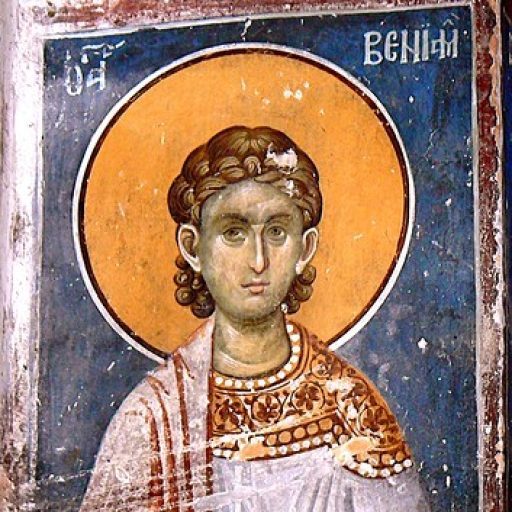
St. Benjamin, St. Anna, St. Stephen, St. Mary of Egypt, St. Peter, St. Andrew, St. Athanasius, St. Nicodemus, and St. Cornelius, pray for us.


 Tribe of Benjamin
Leave a comment